The Strategic Landscape of ADU Development in Pasadena
The residential real estate landscape in Pasadena, California, has undergone a fundamental structural shift driven by state-mandated density initiatives and local regulatory responses. For the Pasadena homeowner, the Accessory Dwelling Unit (ADU)—colloquially known as a guest house, granny flat, or casita—has evolved from a niche home improvement project into a significant capital investment strategy. The convergence of California’s aggressive housing legislation and Pasadena’s specific municipal ordinances has created a complex development environment characterized by distinct opportunities and hidden regulatory pitfalls.
As of 2025, the decision to construct an ADU in Pasadena is no longer merely an architectural question but a financial and regulatory calculus. Homeowners are presented with a bifurcated path: the traditional, highly customizable route of bespoke design, or the streamlined, cost-subsidized path offered by the City’s Pre-Approved Standard Plans Program. The implications of this choice are profound, influencing permitting timelines, hard construction costs, and the ultimate capitalization rate of the asset.
This report serves as a comprehensive feasibility analysis for the Pasadena property owner. It moves beyond generic construction estimates to provide a “true price” analysis grounded in the specifics of the Pasadena Municipal Code (PMC), the 2024-2025 fee schedules, and the critical February 2025 findings from the California Department of Housing and Community Development (HCD). The analysis dissects the nuances of setback geometry—specifically the often-overlooked five-foot requirement for fenestration—the tiered system of impact fee waivers, and the economic realities of labor and material markets in Los Angeles County.
Part I: The Regulatory Blueprint – Navigating Pasadena Municipal Code Title 17
The foundational step in any ADU feasibility study is establishing the “by-right” development envelope. Since 2017, the California legislature has systematically dismantled local barriers to ADU construction, replacing discretionary approvals with ministerial review processes. However, the City of Pasadena retains specific regulatory controls within the bounds of state law, particularly regarding historical preservation, hillside districts, and specific fire safety configurations.
The Development Envelope: Permitted Units and Density
The categorization of the property determines the allowable density. Under current regulations, explicitly updated to align with state mandates, Pasadena permits a layered approach to density on single-family lots. The code facilitates the construction of a Junior Accessory Dwelling Unit (JADU) in conjunction with a detached ADU, effectively allowing a triplex configuration on land zoned for single-family use.
Junior Accessory Dwelling Units (JADUs):
The JADU represents the path of least resistance for density. Limited to a maximum of 500 square feet, this unit must be contained entirely within the walls of the proposed or existing single-family residence, attached garage, or other non-habitable attached space. A critical distinction in the Pasadena code is that JADUs may share sanitation facilities with the primary residence, although they require an efficiency kitchen. This unit type is exempt from many of the burdensome separation requirements applied to detached structures.
Detached and Attached ADUs:
For standard ADUs, the development standards bifurcate based on the connection to the primary dwelling. Detached units function as independent structures. The state mandates that local agencies must permit at least an 800 square foot accessory dwelling unit. However, Pasadena’s code allows for larger units contingent on lot size. For parcels exceeding 10,000 square feet, detached ADUs may expand to 1,200 square feet, provided they contain more than one bedroom, offering a significant advantage for owners of larger estate properties in neighborhoods such as Linda Vista or Madison Heights. Attached ADUs are subject to a stricter containment rule, capped at the greater of 800 square feet or 50% of the primary dwelling’s living area.
The Geometry of Setbacks: The 4-Foot vs. 5-Foot Criticality
Perhaps the most frequent source of compliance failure in preliminary ADU designs within Pasadena is the misinterpretation of setback requirements. While state law (AB 68 and subsequent bills) popularized the “four-foot setback” standard, Pasadena’s implementation includes a critical fire-safety overlay that alters the buildable footprint.
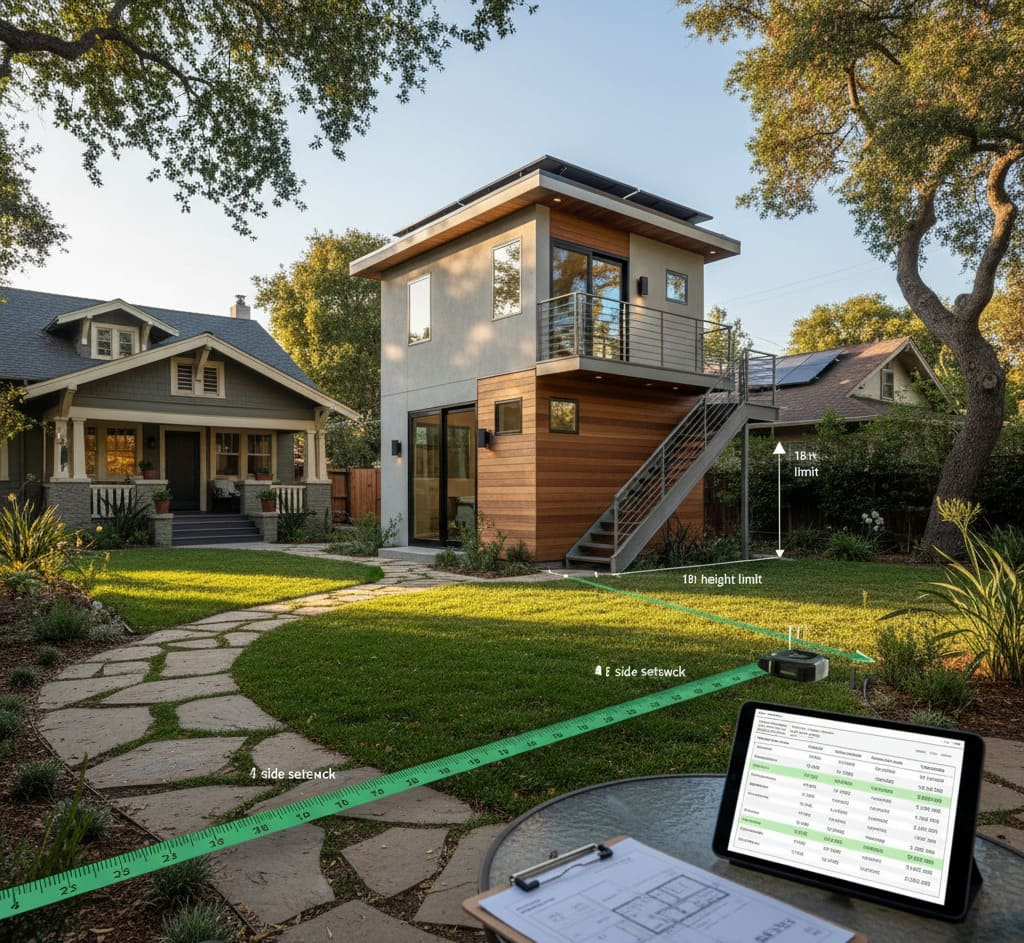
The baseline requirement for newly constructed detached ADUs is a minimum setback of four feet from the side and rear property lines. This aligns with California Government Code section 66321. However, the Pasadena Municipal Code introduces a restriction based on the presence of “openings.” Any exterior wall containing doors or windows must maintain a minimum setback of five feet from the side and rear property lines.
This single regulatory detail necessitates a sophisticated approach to floor plan orientation. To maximize the use of the lot width, a designer must often place the ADU structure four feet from the property line but leave that specific façade blank (without windows), orienting all glazing toward the interior of the lot or the front/rear elevations where deeper setbacks can be accommodated. Failure to account for the extra foot of clearance for windows can result in a failed plan check or the need for costly fire-rated window assemblies that do not open, significantly impacting the habitability and natural ventilation of the unit.
Front Yard Setbacks and State Preemption:
Historically, Pasadena strictly prohibited ADUs in the front yard setback. However, recent legislative updates, specifically SB 897, have challenged this prohibition. The current regulatory environment dictates that if an 800 square foot ADU cannot be accommodated elsewhere on the lot due to site constraints, it must be allowed in the front setback. The HCD’s February 2025 review of Pasadena’s ordinance specifically flagged this issue, noting that the city must explicitly clarify that the 800 square foot entitlement overrides local front yard prohibitions. Homeowners with shallow backyards should view this as a potential entitlement pathway, though it may require assertive engagement with the planning department.
The Height Envelope and Transit Bonuses
The vertical limit for ADUs in Pasadena is generally set at 16 feet, typically accommodating a single-story structure. This height limitation is designed to preserve the privacy of neighboring parcels in single-family zones. However, regulatory exceptions exist to promote density near infrastructure. If the property is located within one-half mile walking distance of a major transit stop or a high-quality transit corridor, the allowable height increases to 18 feet. Furthermore, an additional two feet may be granted to align the roof pitch of the ADU with the primary dwelling, a crucial provision for maintaining architectural continuity in Pasadena’s craftsman and bungalow neighborhoods.
Parking Requirements and Strategic Exemptions
Historically, the requirement to provide off-street replacement parking was a “poison pill” for ADU projects, often necessitating the destruction of backyard space to pour concrete. The current code represents a paradigm shift, offering broad exemptions that effectively eliminate the parking requirement for the vast majority of ADU projects in Pasadena.
Homeowners are exempt from providing any additional parking for the ADU if the project meets one of the following criteria:
- Transit Proximity: The unit is located within one-half mile walking distance of public transit. Given Pasadena’s extensive bus network and Metro Gold Line, this covers a substantial portion of the city.
- Historic Districts: The unit is located within an architecturally and historically significant historic district. This is particularly relevant for Pasadena, which has numerous designated landmark districts.
- Integration: The ADU is part of the proposed or existing primary residence or an accessory structure (e.g., a garage conversion).
- Permit Restrictions: The property is in an area where on-street parking permits are required but not offered to the occupant of the ADU.
- Car Share: A car-share vehicle pick-up/drop-off location is within one block of the ADU.
It is crucial to note that while the ADU itself may not require parking, the conversion of an existing garage may trigger a requirement to replace the parking for the primary residence, depending on the specific zone and the interpretation of “replacement” parking under state law. However, current state law generally allows replacement parking to be located in any configuration on the same lot, including covered, uncovered, or tandem spaces on an existing driveway, drastically reducing the cost burden.
Table 1: Pasadena ADU Development Standards Matrix
| Feature | Regulatory Standard | Key Constraint / Exception |
|---|
| Max Size (Detached) | 800 sq. ft. (Standard)
1,200 sq. ft. (Lots > 10,000 sq. ft.) | Larger units (>800 sq. ft.) must maintain 6′ separation from other structures. |
| Max Size (Attached) | 50% of primary dwelling or 800 sq. ft. | Whichever is greater applies. |
| Max Size (JADU) | 500 sq. ft. | Must be within existing walls/envelope. |
| Height Limit | 16 feet | Increases to 18′ near transit; +2′ for roof pitch matching. |
| Setbacks (Side/Rear) | 4 feet | Critical: 5 feet required for any wall with doors/windows. |
| Parking | 1 space per unit (unless exempt) | Exemptions apply for transit, historic districts, and conversions. |
| Solar Requirement | Yes (Title 24) | Required for new detached construction; exemptions for some shading. |
| Fire Sprinklers | Generally Not Required | Only required if the primary house has sprinklers or potentially for difficult access. |
Part II: The HCD Compliance Gap – Risks and Opportunities
A sophisticated analysis of the Pasadena market must address the current friction between the City’s adopted ordinance (No. 7420) and the oversight of the California Department of Housing and Community Development (HCD). In February 2025, HCD issued a findings letter identifying several areas where Pasadena’s ordinance failed to comply with state law. This regulatory dissonance creates a unique environment for the applicant.
The primary area of contention is the “Front Yard Setback.” HCD explicitly noted that Pasadena’s ordinance attempts to limit attached ADUs of 800 square feet from existing in the front setback. State law (Government Code section 66321) prohibits local agencies from imposing setback limits that preclude the construction of an 800 square foot unit. For a homeowner with a lot configuration that prevents backyard construction (e.g., due to topography, oak trees, or existing pool structures), this state-level “override” provides a legal mechanism to force approval of a front-yard unit, despite local resistance.
Furthermore, the HCD review highlighted discrepancies regarding multi-family dwelling allowances. Senate Bill 1211 (2024) expanded the allowances for detached ADUs on multi-family lots to up to eight detached units, or the number of existing units, whichever is less. Pasadena’s ordinance had not fully integrated this expansion, creating a potential entitlement lag. Investors in multi-family properties in Pasadena should rely on the state statute (SB 1211) rather than the potentially outdated local text when calculating unit yield.
Part III: The Strategic Shortcut – Pasadena’s ADU Standard Plans Program
In response to the complexities of custom permitting and the urgent need for housing stock, the City of Pasadena launched the ADU Standard Plans Program. This initiative functions as a “plug-and-play” development model, offering pre-approved architectural designs that significantly reduce the soft costs and administrative friction associated with building a guest house. For the pragmatic homeowner, this program represents the most efficient path to project completion.
The Product: Analyzing Prototypes A and D
The city offers a portfolio of designs, but two prototypes stand out as the most relevant for the typical single-family zoning application: Prototype A (The Efficiency Studio) and Prototype D (The Family Unit).
Prototype A: The Studio (374 sq. ft.)
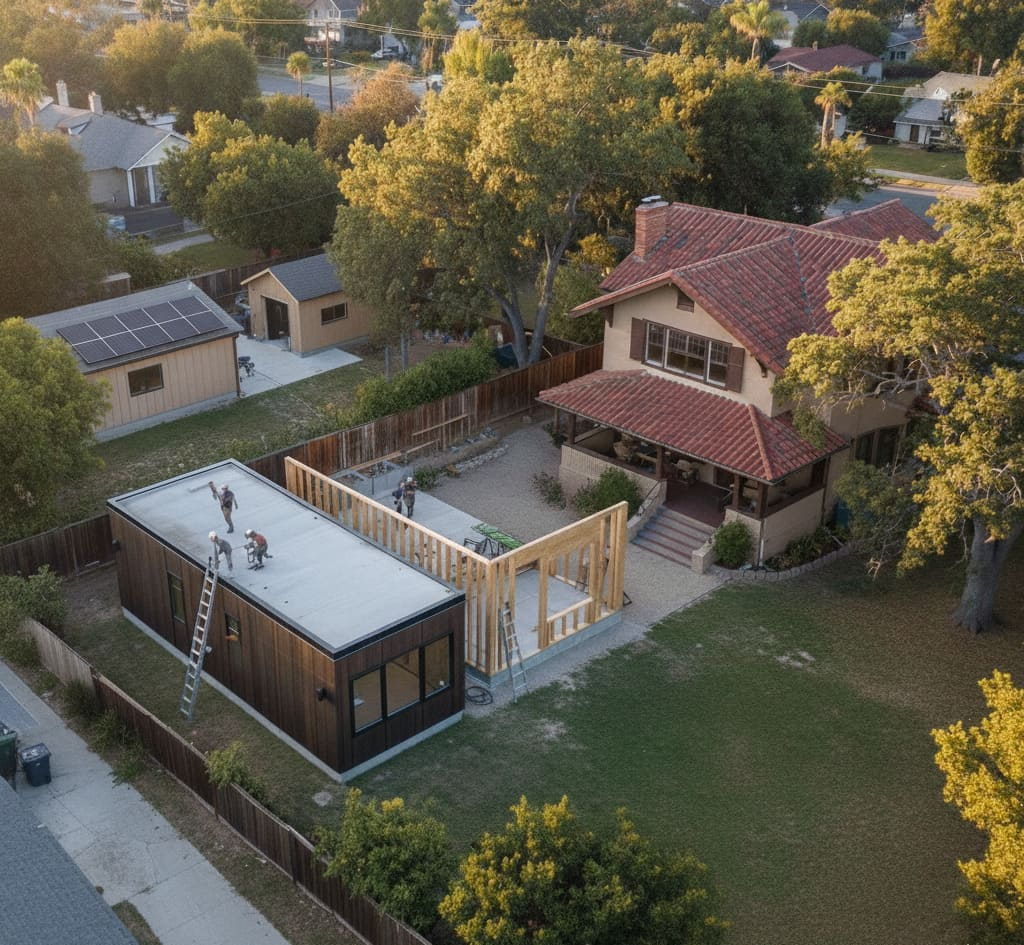
Designed for maximum efficiency on smaller lots, Prototype A is a compact studio unit. With a footprint of approximately 374 conditioned square feet, it is engineered to fit into the tight backyard geometries typical of Pasadena’s denser neighborhoods. The design features a simple rectangular massing to minimize corner complexity and roof framing costs.
- Layout: Open concept living/sleeping area, compact kitchen, and a full bathroom.
- Exterior: Craftsman-inspired aesthetic to blend with local architecture.
- Ideal Use Case: Rental unit for single professionals, student housing (given proximity to PCC and Caltech), or a home office/gym.
Prototype D: The Two-Bedroom (682 sq. ft.)
Prototype D represents a more substantial dwelling, positioning the ADU as a viable family home rather than a transient guest suite. At 682 square feet, it sits comfortably under the 800 square foot threshold that triggers impact fees (discussed in Part IV) while maximizing rental utility.
- Layout: Two distinct bedrooms, one bathroom, and a dedicated living area. It includes a 72 square foot covered front porch, adding usable outdoor living space—a critical amenity in the Southern California climate.
- Dimensions: The structure typically employs a single-story gable roof design with a height of roughly 11′-6″, well below the maximum allowance, reducing visual bulk and neighbor objections.
- Ideal Use Case: Multi-generational housing (aging parents), small family rental, or high-yield long-term rental.
The Economic Leverage of Standardization
The primary value proposition of the Standard Plans Program is not merely architectural; it is financial. The City of Pasadena has incentivized the use of these plans through a robust fee-reduction structure that alters the project’s return on investment (ROI).
- Direct Fee Waivers: The City Council approved significant fee reductions in 2025. For projects utilizing the Standard Plans:
- Plan Check Fees: Discounted by 50%. This is a direct reduction in the cost paid to the building department to review the drawings.
- Permit Fees: The General Plan Maintenance Fee and Technology Fee are fully waived. The Construction Tax is also waived for Standard Plan usage.
- Residential Impact Fees (RIF): Perhaps the most significant saving, the ADU is exempt from Residential Impact Fees. For a custom build, these fees can run into the thousands of dollars, calculated on a per-unit or per-square-foot basis.
- Soft Cost Elimination: A custom architectural design for an ADU in Pasadena typically commands fees ranging from $8,000 to $20,000 depending on the firm and complexity. The Standard Plans provided by the City are available at no cost for the design itself. The homeowner pays only for the site plan preparation and site-specific engineering (if required), effectively erasing a five-figure line item from the budget.
- Time-Value of Money: The permitting timeline for custom ADUs in Pasadena has historically ranged from 4 to 8 months (16-32 weeks) or longer depending on revisions and Design Commission reviews in historic districts. The Standard Plans Program accelerates this process significantly. Because the structure and life-safety components are pre-vetted, the plan check focuses almost exclusively on the site plan (setbacks, utility connections). This can compress the approval timeline to approximately 30-60 days, allowing for a faster start to construction and quicker stabilization of rental income.
Limitations of the Standard Path
The program is not a panacea. The most significant restriction is the prohibition on modification. The city is explicit: “Modifications or customizations to ADU Standard Plans are not allowed, regardless of how minor the changes are”. This means if a homeowner wants to move a window to capture a mountain view or shift a wall to accommodate a specific piece of furniture, the plan loses its “Standard” status and reverts to the full plan check process with full fees. Additionally, the plans are designed for flat lots with standard soil conditions. If a property is on a hillside or has expansive soil, a geotechnical report and custom foundation engineering will still be required, eroding some of the cost savings.
Table 2: Cost-Benefit Analysis – Custom Design vs. Pasadena Standard Plan (Prototype D)
| Cost Category | Custom Design (682 sq. ft.) | Standard Plan (Prototype D) | Estimated Savings |
|---|
| Architectural Design | $8,000 – $15,000 | $0 (City Provided) | $8k – $15k |
| Plan Check Fee | Full Fee (~$2,500+) | 50% Reduction | ~$1,250 |
| Construction Tax | Full Tax | Waived | Variable |
| Residential Impact Fee | Assessed (>900sf) / Exempt (<750sf) | Waived | Variable |
| Permit Processing Time | 4 – 8 Months | 1 – 2 Months | 3-6 Months Rent |
| Flexibility | High (Custom layout/finish) | None (Fixed layout) | (Intangible Cost) |
Part IV: Deconstructing the “True Cost” of Construction
Developing an accurate budget for an ADU in Pasadena requires a granular understanding of the “Hard” and “Soft” costs. Public estimates often cite a “cost per square foot” that ignores site work, utility connections, and permitting fees, leading to dangerous undercapitalization.
Soft Costs: The Hidden Entry Price
Soft costs represent the expenses incurred before a shovel hits the ground. In Pasadena, even with fee reductions, these are substantial.
- Site Survey & Topography: Essential for establishing the 4-foot/5-foot setbacks accurately. Cost: $1,500 – $3,000.
- Soil/Geotechnical Report: Pasadena has zones of expansive soil and liquefaction. While the Standard Plan assumes flat/standard soil, many lots will trigger a requirement for a soils report to verify foundation bearing capacity. Cost: $2,000 – $5,000.
- Structural Engineering: If converting a garage, the existing structure almost never meets current seismic codes. Engineering retrofits are mandatory. Cost: $2,500 – $5,000.
- School Fees: The Pasadena Unified School District (PUSD) levies developer fees. However, ADUs under 500 square feet are exempt. For units over 500 square feet, fees are levied per square foot of assessable space.
Hard Costs: Construction Reality in 2025
Hard costs fluctuate based on material availability and labor demand. In the Los Angeles basin, labor rates for skilled trades (plumbing, electrical, framing) remain high.
1. Garage Conversion Costs:
Often perceived as the “cheap” option, garage conversions in Pasadena typically cost between $125 and $200 per square foot.
- The Trap: The existing slab is rarely rated for habitation (lacking moisture barriers and footings). The walls often need to be furred out for insulation, and the roof structure may need reinforcement for solar loading or drywall weight.
- Total Budget: A typical 400 sq. ft. detached garage conversion generally lands between $100,000 and $150,000 “all-in”.
2. New Detached Construction:
Ground-up construction offers predictability but at a higher price point. Costs typically range from $300 to $450+ per square foot for custom builds.
- Standard Plan Efficiency: Using a Standard Plan can drive this toward the lower end ($250-$300/sq. ft.) by eliminating design ambiguity and allowing contractors to bid on a known quantity.
- Total Budget: A 682 sq. ft. unit (Prototype D) will likely cost between $180,000 and $280,000 depending on finish quality (flooring, cabinets, windows).
The Utility Connection Variable
A frequently underestimated line item is utility connections. Pasadena Water and Power (PWP) and the sanitation district have specific requirements.
- Sewer: If the ADU cannot gravity-feed to the existing lateral due to elevation, a sewage ejector pump is required (~$3,000). If a new lateral is required to the main in the street, costs can exceed $10,000 due to street trenching and encroachment permits.
- Power: Upgrading the main electrical panel (e.g., from 100A to 200A) to support the ADU is common. Cost: $3,000 – $5,000.
- Total Utility Budget: Homeowners should carry a contingency of $10,000 – $15,000 specifically for utility trenching and connection fees.
Table 3: Estimated Total Project Budget (2025)
| Cost Component | Garage Conversion (400 sf) | Standard Plan New Build (682 sf) | Custom New Build (800 sf) |
|---|
| Soft Costs (Plans/Eng) | $5,000 – $8,000 | $2,000 – $4,000 | $15,000 – $25,000 |
| Permits & Fees (City) | $2,000 – $4,000 | $1,000 – $2,000 (Waived) | $10,000 – $16,000 |
| Site Work/Demo | $2,000 – $5,000 | $5,000 – $10,000 | $8,000 – $15,000 |
| Construction (Labor/Mat) | $100,000 – $130,000 | $170,000 – $210,000 | $280,000 – $350,000 |
| Utilities | $5,000 – $8,000 | $8,000 – $12,000 | $10,000 – $15,000 |
| Total Estimated Cost | $114,000 – $155,000 | $186,000 – $238,000 | $323,000 – $421,000 |
Part V: Financing and ROI – The Pasadena Second Unit ADU Program
For homeowners lacking the liquidity to self-finance a $200,000 project, the City of Pasadena offers a distinct capital advantage through the Second Unit ADU Loan Program. This program is specifically designed to incentivize the creation of affordable housing.
The Loan Structure:
The program offers a construction loan of up to $225,000 at a simple interest rate of 1%. Payments are deferred for the first three years. This below-market financing effectively subsidizes the hard costs of construction, altering the capitalization rate of the project significantly.
The “Catch”: Affordable Housing Covenant:
In exchange for this subsidized capital, the homeowner must agree to rent the ADU to a tenant with a Housing Choice Voucher (Section 8) for a period of seven years. While this restricts the ability to rent the unit at top-of-market luxury rates or use it for short-term rentals (Airbnb), it guarantees a steady, government-backed income stream. Furthermore, the program includes “Full Project Management,” where a city-assigned case manager oversees the design, permitting, and contractor selection process, reducing the project management burden on the homeowner.
ROI Analysis:
Even with the restricted rent of a voucher tenant, the ROI on a 1% loan is substantial. If a homeowner borrows $200,000 at 1% and generates $2,000/month in rent, the positive leverage is immediate. Conversely, a homeowner financing a custom build at current HELOC rates (often 7-9%) faces a much higher breakeven point.
Part VI: Strategic Action Plan – The Permitting Pathway
Navigating the bureaucracy of the Permit Center requires a disciplined, step-by-step approach. The following roadmap integrates the standard requirements with the specific nuances of the Pasadena process.
Phase 1: Feasibility & Pre-Design
- Virtual Consultation: Before spending a dollar, book a complimentary “Virtual Consultation” with City staff. This is a unique service offered by Pasadena to verify zoning and setbacks preliminarily.
- Utility Reconnaissance: Locate the sewer cleanout and main electrical panel. Determine if the panel has open breaker slots and the capacity for an additional 40-60 amps of load.
- Plan Selection: Decide between the “Standard Plan” route (speed/cost) or “Custom” (flexibility). Download the PDF of the selected Standard Plan (e.g., Prototype D) to verify it fits within the 4-foot/5-foot setback envelope on the site plan.
Phase 2: Application & Submission
- Prepare the Site Plan: Even for Standard Plans, the homeowner must submit a site plan drawn to scale. This must show the entire lot, existing structures, trees (specifically protected native oaks), and the proposed ADU location with dimensions to property lines. Critical Check: Ensure windows are 5 feet from property lines.
- Hold Harmless Agreement: Complete the city’s indemnity agreement, a standard requirement for using their pre-approved designs.
- Portal Submission: Submit all documents via the Pasadena Citizen Self-Service (CSS) Portal. Select “Accessory Dwelling Unit” and tag the application with “ADU Standard Plan” in the description to trigger the fee waivers and expedited routing.
Phase 3: Execution
- Plan Check Corrections: Even Standard Plans may receive corrections regarding site-specific issues (e.g., “Show path of travel to the street” or “Verify distance to fire hydrant”). Respond to these immediately to maintain the expedited timeline.
- Permit Issuance: Once approved, pay the reduced fees (School Fees, reduced C&D deposit of $1,000) and pull the building permit.
- Construction: Hire a General Contractor (GC) with experience in Pasadena. The city’s inspections are rigorous; ensure the GC is familiar with the specific “fire separation” details required for ADUs close to the primary residence (usually a 1-hour fire-rated wall if within 6 feet).
Conclusion
The construction of an ADU in Pasadena represents a convergence of regulatory opportunity and economic calculation. The era of discretionary uncertainty is largely over, replaced by a ministerial process that favors the prepared applicant.
For the investor-owner seeking maximum yield and minimum duration, the Prototype D Standard Plan utilizing the fee waivers and potentially the City Loan Program is the dominant strategy. It minimizes soft costs, accelerates entitlement, and leverages subsidized capital.
However, for the homeowner dealing with irregular lot geometries, protected oak trees, or a desire for architectural integration with a historic primary residence, the custom path remains necessary. In this scenario, success hinges on a rigorous adherence to the setback geometries—specifically the five-foot fenestration rule—and a realistic budget that accounts for the $350-$450/sq. ft. reality of the current construction market.
Ultimately, the “true price” of a Pasadena ADU is not just the construction contract; it is the sum of the design fees, the city impact charges, the utility upgrades, and the opportunity cost of time. By leveraging the specific exemptions and Standard Plans detailed in this report, a Pasadena homeowner can reduce that true price by upwards of 20-30%, turning a complex construction project into a viable and lucrative asset.